Hello and welcome to this technical engineering guide. At ZHERUTONG, we are a dedicated manufacturer of premium 3 phase busbar trunking systems, and we take immense pride in sharing our factory-level expertise with electrical engineers, commercial building contractors, and project managers worldwide. As a leading manufacturer, we understand that designing a robust electrical distribution network is no small feat. You are likely here because you need to understand how to size 3 phase busbar trunking system for commercial building applications safely and efficiently. Through our years of manufacturing and engineering experience, we have seen firsthand how proper sizing dictates the long-term reliability of an entire facility. In this comprehensive guide, we are going to walk you through the exact engineering calculation methods, load assessments, and spatial considerations required to ensure your commercial project operates flawlessly without risking safety or wasting your capital budget.
Precise sizing ensures your electrical distribution network safely handles peak commercial loads without wasting budget on over-specified materials, serving as the foundation of a reliable power infrastructure. As a manufacturer, we at ZHERUTONG constantly remind our engineering partners that the stakes in commercial buildings are incredibly high. These facilities host a unique ecosystem of power demands, including massive HVAC chillers, dense server rooms, continuous elevator operations, and extensive lighting networks. If you underestimate these requirements and undersize your 3 phase busbar trunking, the consequences are severe. Undersized conductors experience excessive electrical resistance, leading to dangerous overheating, severe voltage drops at the furthest distribution boards, and ultimately, catastrophic fire hazards that threaten life safety and property.
Conversely, oversizing the system is a common trap that inexperienced designers fall into when trying to play it safe without proper calculations. While it certainly prevents overheating, oversizing requires an unnecessary capital expenditure on heavier, much more expensive materials. Furthermore, oversized systems consume valuable spatial footprint within the electrical riser shafts. Commercial real estate is expensive, and every square meter dedicated to unnecessarily large electrical components is a square meter lost to usable, rentable space. By mastering the sizing process, you strike the perfect balance between uncompromising safety and economic efficiency. Accurate sizing guarantees that the infrastructure serves the building perfectly throughout its lifespan while keeping initial procurement costs strictly aligned with actual engineering necessities.
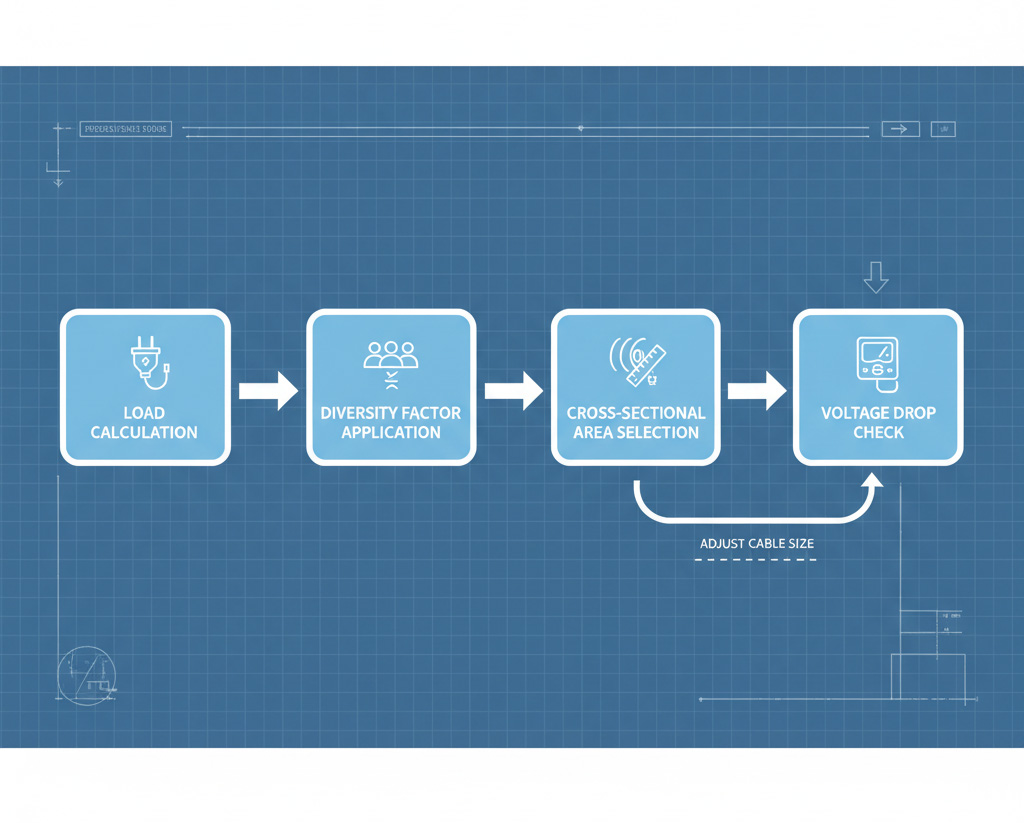
You must calculate the total connected load, apply appropriate diversity factors, and rigorously verify voltage drop across the entire run length to guarantee optimal current density selection. Understanding exactly how to size 3 phase busbar trunking system for commercial building projects begins with grasping the foundational mathematics of three-phase alternating current power. The core equation you will rely on is total power equals the square root of three multiplied by voltage, current, and the power factor. By rearranging this formula to solve for current, you establish the baseline amperage required to support the facility. However, merely calculating the raw current is only the first step in our factory-recommended workflow.
You must also account for the physical characteristics of the conductor material, whether you are utilizing high-purity copper or lightweight aluminum. Different materials possess different thermal conductivities and impedance values, which directly dictate the required cross-sectional area of the busbars to maintain an acceptable current density. In typical commercial manufacturing standards, current density is carefully regulated to ensure the system does not exceed its maximum temperature rise limit under continuous full-load operation. At ZHERUTONG, we engineer our 3 phase busbar trunking systems to maintain exceptional thermal stability, but that stability relies entirely on the design engineer selecting the correct initial capacity based on accurate mathematical modeling. This systematic approach eliminates guesswork, prevents the dangerous assumption that all loads will draw maximum power simultaneously, and provides a mathematically sound basis for your procurement phase.
The expected total load is determined by summing all individual electrical demands and multiplying them by a standard commercial diversity factor to prevent overestimating the continuous power requirement. To begin this phase, you must meticulously catalog every single connected load within the commercial building blueprint. This inventory includes general lighting circuits, heavy-duty HVAC compressors, water pumps, elevator motors, and general plug loads for office equipment. It is also crucial to account for harmonic loads generated by modern electronic devices, which can place additional stress on the neutral conductor. Once you have calculated the absolute maximum theoretical load, you must apply a diversity factor.
A diversity factor acknowledges the practical reality that a commercial building rarely, if ever, operates at one hundred percent simultaneous load. For instance, not every elevator is lifting maximum weight at the exact same millisecond that every air conditioning compressor kicks on and every single light switch is flipped. By applying a diversity factor—often ranging between zero point six and zero point eight depending on the specific zone and local electrical codes—you derive the maximum demand load. Let us consider a hypothetical scenario where a commercial office floor has a theoretical connected load of six hundred amperes. By applying a diversity factor of zero point seven, the actual demand load drops to four hundred and twenty amperes. This realistic figure is what you will use to select the appropriate 3 phase busbar trunking rating, ensuring you do not drastically over-engineer the system while still maintaining a robust safety margin for future tenant expansions.
You manage voltage drop by ensuring that the calculated drop along the busbar run remains strictly below the standard acceptable limit of three to five percent. Even if your initial load calculations are flawless, the physical length of the commercial building's riser shaft introduces a new challenge known as voltage drop. As electrical current travels through the 3 phase busbar trunking, it encounters inherent resistance and reactance within the conductor material. Over long vertical distances, such as those found in high-rise commercial towers, this impedance causes the voltage at the furthest distribution board to be noticeably lower than the voltage at the main incoming switchgear.
If this drop exceeds the acceptable threshold, sensitive electronic equipment, lighting ballasts, and heavy motors will suffer from reduced efficiency, increased heat generation, and premature failure. To calculate this, you must use the manufacturer-provided impedance values for the specific busbar rating you have selected. The formula factors in the current, the length of the run, the resistance, and the reactance. If your calculation reveals a voltage drop exceeding five percent, you must select a larger cross-sectional area for your busbar, even if the original size was technically sufficient for the raw amperage. A larger conductor inherently possesses lower resistance, thereby mitigating the voltage drop and ensuring stable, high-quality power delivery to the very top floor of the commercial building.
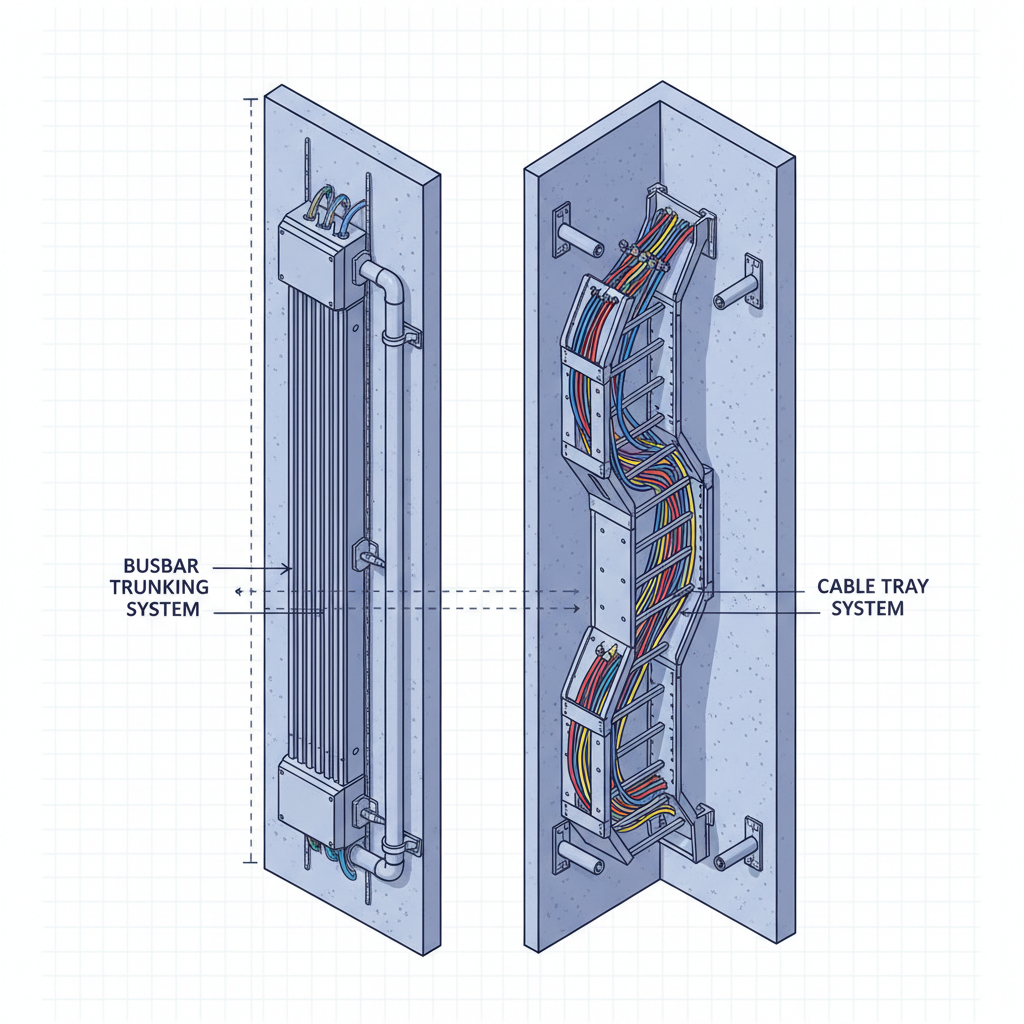
Busbar trunking offers vastly superior space efficiency, faster installation times, and significantly better heat dissipation compared to traditional bulky cable setups, making it the premier choice. When engineering a modern facility, conducting a thorough 3 phase busbar trunking vs cable tray power distribution comparison is an essential step in the design phase. For decades, engineers relied on pulling massive bundles of heavy copper cables through extensive tray networks. However, as commercial buildings grow taller and power demands become denser, the limitations of traditional cables become glaringly obvious. The most immediate advantage revealed in any 3 phase busbar trunking vs cable tray power distribution comparison is the dramatic reduction in spatial footprint.
Riser shafts in commercial real estate are incredibly valuable. Traditional cable trays require massive bending radii, significant spacing between cables to prevent thermal runaway, and large support structures that eat into the building's core. In stark contrast, our ZHERUTONG busbar systems feature a highly compact, sandwich-type construction that occupies up to fifty percent less space in the shaft. This allows architects to shrink the electrical rooms and maximize rentable floor space, instantly increasing the commercial viability of the real estate project.
Furthermore, thermal performance is a critical differentiator. When multiple cables are bundled together in a tray, the inner cables struggle to dissipate heat, requiring engineers to apply heavy de-rating factors that force the use of even thicker, more expensive cables. Our manufactured busbar systems utilize extruded metal enclosures that act as massive heat sinks, providing exceptional thermal conductivity and lower overall impedance.
Finally, the installation process heavily favors the modern approach. A comprehensive 3 phase busbar trunking vs cable tray power distribution comparison must account for expensive labor hours. Pulling thick, rigid cables up a fifty-story vertical shaft is a grueling, dangerous, and time-consuming process that requires large teams of specialized technicians and heavy winching equipment. Conversely, our busbar systems are manufactured in standardized, modular lengths with plug-and-play joint blocks. A small team can simply bolt these sections together as they move up the shaft, often cutting installation labor time by more than half. This rapid deployment not only saves massive amounts of money on contractor fees but also aggressively accelerates the overall project timeline, allowing the commercial building to open its doors to tenants much sooner.
We successfully engineered a customized, space-saving power distribution layout for a high-rise commercial complex in the UAE that was struggling with severe spatial constraints and voltage drop issues. To truly illustrate the value of partnering with an expert manufacturer, we want to share a detailed, real-world engineering challenge we recently solved. A prominent commercial tower developer in the United Arab Emirates approached ZHERUTONG with a critical infrastructure crisis. They were constructing a forty-five-story luxury commercial complex, but the architectural design had severely limited the dimensions of the central electrical riser shafts. Their initial engineering firm had attempted to design a traditional cable tray system, but the sheer volume of cables required to power the massive HVAC chillers and luxury tenant spaces simply could not physically fit inside the narrow shafts.
To make matters worse, the ambient temperatures in the UAE frequently soar up to fifty degrees Celsius during the peak summer months. This extreme heat required severe thermal de-rating of the proposed cables, meaning they needed even thicker cables that they already had no room for. The project was at a complete standstill, and the developers were facing massive daily delay penalties. They did not know how to proceed without completely redesigning the building's concrete core.
They reached out to ZHERUTONG for a manufacturing intervention. Our engineering team immediately took over the sizing calculations. We recalculated their entire load profile, applying the precise temperature de-rating factors specific to our high-performance insulation materials. We determined that a customized, aluminum-housed 3 phase busbar trunking system would be the perfect solution. Because we are the manufacturer, we had the capability to custom-fabricate the exact lengths and specialized elbow joints required to navigate their incredibly tight riser shafts. We engineered a dual-run layout using our compact sandwich-design busbars, which inherently provided vastly superior heat dissipation compared to the bundled cables they originally planned to use. Furthermore, we upgraded the enclosure to a high IP rating to protect against the fine desert dust prevalent in the region.
The results were transformative. Our tailored sizing and manufacturing solution fit perfectly into the narrow shafts with room to spare for future maintenance access. Despite the extreme vertical climb and the harsh ambient temperatures, our system maintained a highly stable voltage drop of strictly under two point five percent at the top-floor penthouse distribution boards. Furthermore, because our modular joints are designed for rapid assembly, the local contracting team was able to complete the vertical installation forty percent faster than the original cable-pulling schedule had projected. This project perfectly demonstrates why choosing an experienced, highly capable manufacturer like ZHERUTONG is critical for overcoming complex engineering hurdles in modern commercial construction.
You can easily partner with our engineering team by submitting your commercial building blueprints and project specifications directly through the ZHERUTONG website for a comprehensive sizing consultation. Getting the electrical sizing right the very first time is not just a matter of compliance; it is a critical investment in the safety, efficiency, and longevity of your commercial property. As we have detailed throughout this guide, navigating load calculations, diversity factors, voltage drops, and thermal constraints requires a deep understanding of electrical engineering principles and material sciences. You do not have to tackle these complex mathematical challenges alone. ZHERUTONG stands ready as your premier manufacturing partner, bringing decades of factory-floor expertise and field-tested engineering solutions directly to your project.
We highly recommend that you stop relying on guesswork or outdated cable methodologies and let our factory experts assist you in designing a modern, highly efficient power distribution network. We invite all electrical engineers, contractors, and project developers to visit the official ZHERUTONG website today. By leaving your contact information and uploading your preliminary project details or blueprints through our secure portal, our dedicated technical team will provide you with a free, detailed sizing consultation and a highly competitive manufacturing quote. Choose the strength, reliability, and precision of ZHERUTONG, and let us help you power your next great commercial building with absolute confidence.