Категории

How to Evaluate Electrical Busway Manufacturers for Data Center Projects

Six vendors, same compliance claims, similar pricing — learn how to evaluate electrical busway manufacturers for data center projects beyond surface-level checks.
Jun 16th,2026 17 Взгляды

Picture this: a procurement engineer receives six vendor quotations for a 2000A busway system. All six claim IEC 60439 compliance. All six offer similar pricing. All six have polished product brochures. At this point, the standard evaluation process — checking a compliance box, comparing unit prices, maybe Googling brand reputation — completely breaks down. The real differentiators are buried in type test documentation, factory backlog data, and engineering response quality that most vendors never volunteer unless specifically pressured.

At ZHERUTONG, we work through this exact scenario regularly. We receive RFQs from data center developers across Southeast Asia, the Middle East, and Europe, and we've watched procurement processes fail not because engineers made careless decisions, but because they applied a generic industrial evaluation framework to a project environment that demands something fundamentally different. Brand recognition is a starting point, not a decision framework. A "top 10 list" tells you who has the largest marketing budget, not who can deliver a 3200A copper sandwich busway system with non-standard tap-off spacing in 13 weeks with BIM-compatible documentation.

This article lays out a structured evaluation methodology for electrical busway manufacturers specifically calibrated to data center requirements. We'll cover five dimensions: why data centers demand a different standard, what certifications actually mean, how to assess production reliability, what real customization capability looks like, and how to structure a final vendor comparison before committing.

Why Do Data Centers Demand a Different Evaluation Standard?

Data centers impose power continuity requirements, thermal density constraints, and modular scalability demands that simply do not exist in standard industrial distribution — meaning a manufacturer qualified for a factory floor may be fundamentally unprepared for a Tier III or Tier IV data center project.

The distinction matters more than most procurement checklists acknowledge. When a manufacturing plant needs scheduled maintenance, production stops for a few hours and the business absorbs the cost. When a data center loses power continuity, the consequences cascade: SLA violations, customer churn, regulatory exposure, and reputational damage that no busway price difference can offset.

What Makes Data Centers Structurally Different?

Unlike industrial facilities where planned outages are manageable, data centers require busway systems that support live maintenance, redundant feed paths, and zero-tolerance for installation errors.

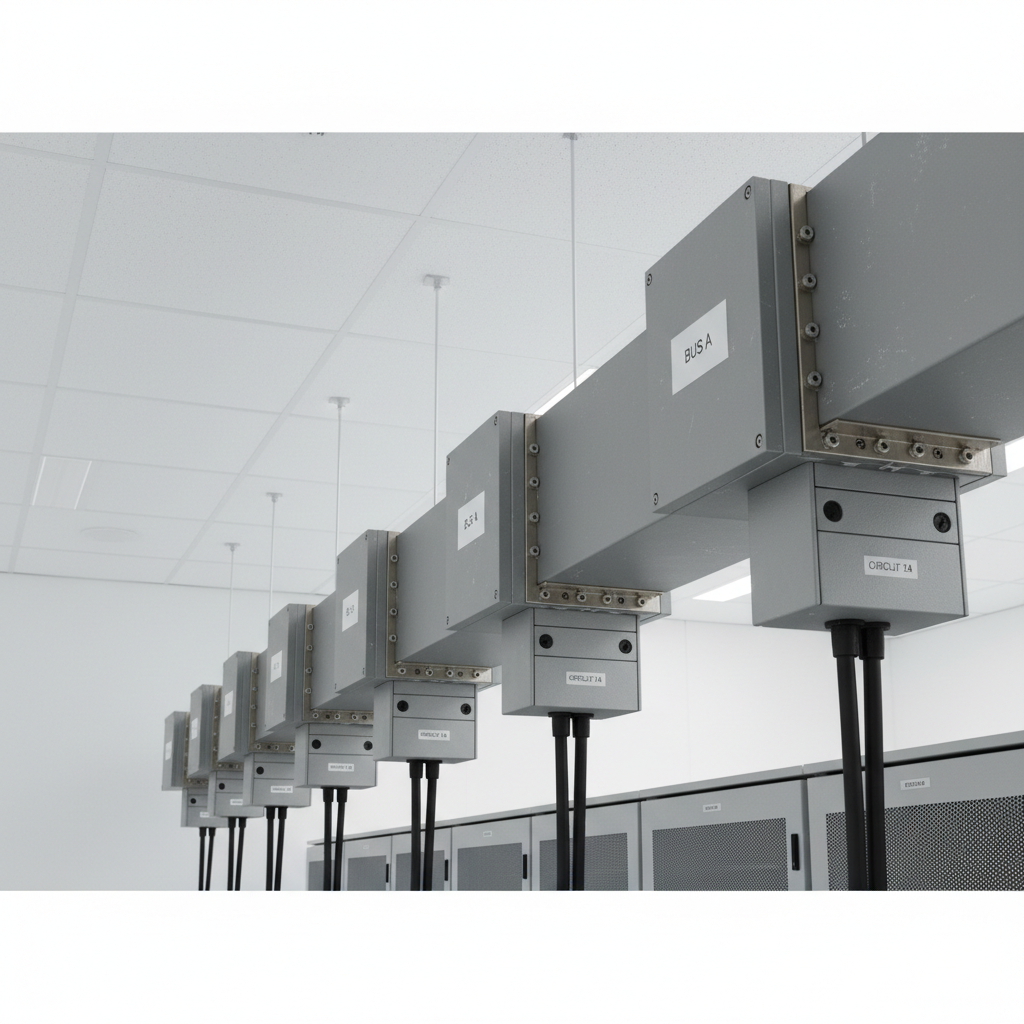
The Uptime Institute's Tier classification system makes this concrete. A Tier III facility requires concurrent maintainability — meaning any component in the power path, including busway, must be serviceable without taking the system offline. A Tier IV facility goes further, requiring fault tolerance: the system must continue operating even during an active failure event. These aren't abstract design preferences; they translate directly into requirements for dual A+B feed paths, tap-off units that can be added or replaced under live conditions, and busway housing designs that don't compromise adjacent circuits during maintenance access.

Thermal management adds another layer of complexity absent from most industrial sites. In a high-density data hall with rack power densities reaching 15–30kW per rack, busway routing must account for hot aisle/cold aisle discipline. A busway run positioned incorrectly can disrupt airflow management and undermine the entire cooling strategy — a problem that has nothing to do with ampacity ratings and everything to do with whether the manufacturer has actually engineered for data center environments before.

Then there's phased expansion. Data centers rarely build to full capacity on day one. They scale in phases, which means the busway infrastructure installed in Phase 1 must accommodate additional tap-off units in Phase 2 and Phase 3 without requiring a full system shutdown. A manufacturer whose product architecture doesn't support this will create expensive rework obligations down the line.

How Do Industrial Power Distribution Standards Apply Here?

The busway manufacturer selection criteria for industrial power distribution overlap with data center requirements on fundamentals like short-circuit rating and IP protection, but diverge sharply on modularity, lifecycle support, and documentation depth.

IEC 61439 and UL 857 provide the baseline compliance framework for both environments. Short-circuit withstand ratings, temperature rise limits, and enclosure protection classes apply across the board. But data center projects layer additional requirements on top: BIM-compatible documentation for EPC contractors, seismic ratings in earthquake-prone regions (particularly relevant across Southeast Asia and parts of the Middle East), EMI shielding considerations for sensitive IT environments, and fire performance compliance under IEC 60332 and NFPA 75.

The critical implication: a manufacturer with a strong track record in industrial power distribution may hold every relevant certification and still lack the engineering infrastructure to execute a data center project correctly. Evaluating a manufacturer's actual capability requires going beyond the certification checklist.

What Certifications Should You Actually Verify?

Holding an IEC or UL certificate does not mean the specific product configuration you're ordering has been tested — and for data center busway, the gap between a manufacturer's certified reference design and your custom specification can represent a significant safety and compliance risk.

This is the most consistently mishandled part of vendor evaluation. Procurement teams request a certificate, receive a PDF with an official-looking stamp, and move on. The problem is that many certificates cover "product families" at a reference rating — not the specific conductor cross-section, current rating, and enclosure dimensions you've actually specified.

Which Certifications Are Non-Negotiable?

At minimum, your electrical busway manufacturer should demonstrate third-party type-tested results under IEC 61439-6 or UL 857, with test reports that match the conductor material, current rating, and enclosure type specified in your project.

IEC 61439-6 covers busbar trunking systems specifically and defines the type test requirements for temperature rise, short-circuit withstand, IP protection verification, and dielectric strength. It does not, however, automatically validate every configuration a manufacturer produces — only the configurations that were physically submitted for testing. UL 857 serves the equivalent function for North American projects and some APAC markets where US-standard compliance is required by the facility owner or local authority.

CE marking deserves particular scrutiny. A CE mark indicates self-declaration of conformity with European directives — it does not require third-party laboratory testing. When a manufacturer presents CE marking as their primary compliance evidence, ask directly: which accredited test laboratory performed the type tests, and can you provide the original reports?

For data center white space applications, IP54 is the practical minimum for busway enclosures. For raised floor plenum installations where airflow carries particulates, IP65 is more appropriate. Short-circuit withstand rating is another data center-specific checkpoint: 50kA for 1 second is a common baseline for data center main distribution, and you need to verify this in the actual test documentation — not the product datasheet.

How Do You Audit a Manufacturer's Test Documentation?

Request the original type test report — not a certificate summary — and verify that the tested configuration matches your specification in conductor cross-section, insulation material, and enclosure dimensions.

A credible test report will identify the accredited laboratory by name (look for CNAS accreditation for Chinese labs, or ILAC-MRA member labs for international recognition), specify the exact configuration tested, include temperature rise measurement data at rated current, and provide short-circuit test waveform data showing the peak and RMS values applied. If any of these elements are missing, the report is incomplete.

Red flags to watch for: certificates with no test laboratory name, reports dated more than ten years ago with no evidence of re-testing after design changes, and certificates that reference "up to 5000A" without specifying which configuration at which rating was actually tested. At ZHERUTONG, we maintain configuration-specific test files for each product family and make these available to project engineers during the qualification stage — not after purchase order issuance. If a manufacturer is reluctant to share test documentation before contract award, that reluctance is itself a data point.

How Do You Assess Production Capacity and Lead Time Reliability?

Production capacity and schedule reliability are as critical as product specification in data center projects, where busway installation sits on the critical path between structural completion and IT commissioning — a six-week delay from a manufacturer can cascade into a multi-month project overrun.

MEP sequencing in data center construction is tightly coupled. Busway installation typically follows structural steel and above-ceiling coordination but precedes IT equipment delivery and commissioning. A manufacturer who delivers late doesn't just create a busway problem — they create a project-level schedule failure that affects every downstream contractor.

What Factory Audit Questions Reveal Capacity Constraints?

The most revealing capacity questions are not about annual output — they're about current order backlog, raw material inventory policy, and whether the manufacturer operates dedicated production lines for data center-grade busway or shares capacity with standard industrial orders.

Copper and aluminum inventory depth is a direct indicator of delivery stability. A manufacturer who spot-buys conductor material at order placement is exposed to commodity price spikes and supply disruptions in ways that a manufacturer with strategic stock is not. During commodity volatility periods, spot-buy manufacturers have historically extended lead times by 4–8 weeks with minimal warning.

Production line segregation matters for quality consistency. Data center busway requires tighter dimensional tolerances than standard industrial busway — particularly for tap-off unit interfaces where misalignment creates both electrical and mechanical risk. A manufacturer who runs data center and standard industrial production on shared lines introduces quality variability that dedicated lines eliminate.

When conducting a factory audit — whether in person or via video — ask specifically: what is your current lead time for 2000A copper busway in a standard configuration? What percentage of your current production capacity is committed to existing orders? What is your final inspection rejection rate? These questions are harder to answer with marketing language than "what is your annual production capacity."

From our project experience at ZHERUTONG, standard configurations (feeder sections in catalog ratings) typically ship within 6–10 weeks from approved drawings. Custom configurations — non-standard tap-off spacing, dual-feed housings, seismic bracing integration — run 10–16 weeks. Phased delivery scheduling, where standard feeder sections ship first and custom tap-off sections follow, can reduce critical-path impact significantly.

Is Regional Manufacturing Presence Important?

For large data center projects, a manufacturer with regional warehousing or a local assembly partner can reduce lead time by 30–50% compared to full ex-works production, while also simplifying customs and on-site technical support logistics.

The trade-off between full OEM production and regional distribution is real. A manufacturer producing entirely at origin may offer better quality control and lower unit cost, but longer transit times and customs complexity can offset those advantages for time-sensitive projects. For projects in Southeast Asia or the Middle East, pre-cut component kits shipped to a regional assembly point can compress the schedule while maintaining manufacturing quality standards.

Documentation accuracy for customs clearance is a practical issue that many procurement teams underestimate. Busway systems span multiple HS code categories depending on conductor material, current rating, and whether tap-off units are included. Incorrect classification creates customs holds that can delay project delivery by weeks. A manufacturer with international project experience will have this documentation infrastructure in place; one without it will be learning on your project timeline.

What Customization Capability Separates Adequate Manufacturers From the Right One?

In data center busway procurement, customization capability is not about cosmetic options — it's about whether the manufacturer can engineer non-standard tap-off positions, mixed conductor configurations, seismic-rated support systems, and project-specific documentation packages without outsourcing the engineering work.

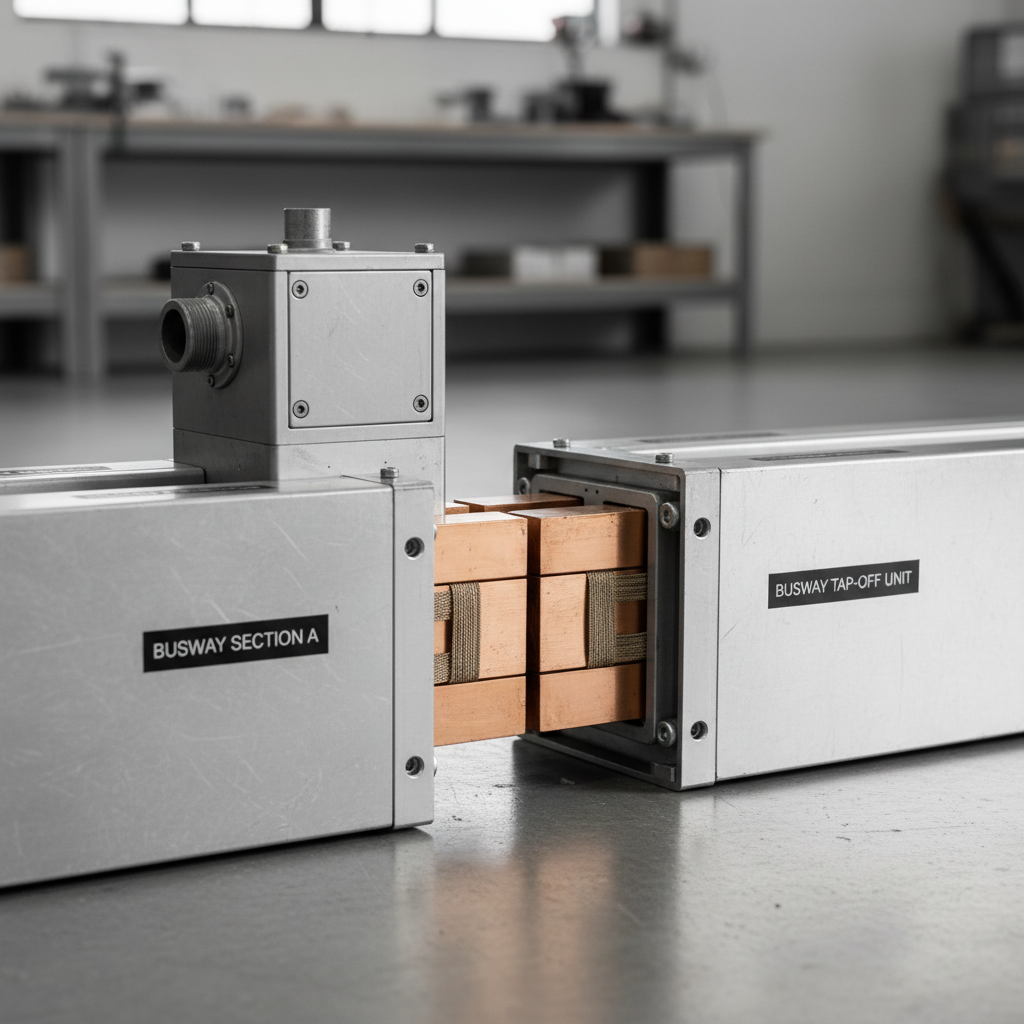
Most manufacturers describe themselves as "customization-capable." In practice, many can adjust housing color, add custom labeling, and modify standard lengths. What they cannot do — or cannot do without significant delay and quality risk — is re-engineer the tap-off interface geometry, design a dual-feed configuration in a single housing, or produce BIM-compatible 3D models alongside shop drawings. These are the capabilities that actually matter for data center projects.

What Are the Most Common Custom Requirements in Data Center Busway?

The three customization requests we encounter most frequently from data center developers are non-standard tap-off spacing to match PDU rack layouts, dual-feed (A+B) busway configurations in a single housing, and project-specific color-coding and labeling for circuit identification.

Standard 600mm tap-off spacing is designed around a generic distribution model. In a high-density data hall with 42U racks at 600mm or 800mm row pitch, standard spacing forces compromises in PDU positioning that create cable management problems and increase installation labor. Non-standard spacing — typically 500mm or 700mm depending on rack layout — requires the manufacturer to re-engineer the tap-off housing interface, not just move a mounting hole.

Dual A+B feed configurations in a single busway housing are increasingly requested for space-constrained overhead routes where running two separate busway systems side by side isn't practical. This is a genuinely complex engineering task: the two feed paths must be electrically isolated within a shared enclosure while maintaining individual accessibility for maintenance, and the thermal modeling must account for combined heat dissipation from both conductors.

Seismic bracing integration is non-negotiable for data centers in earthquake-zone locations. IBC seismic requirements and IEC 60068-3-3 testing protocols define the performance standards, but the actual engineering — calculating support span, bracket geometry, and anchor point loads — must be done by the manufacturer, not left to the installation contractor.

How Do You Test a Manufacturer's Engineering Responsiveness?

Send a non-standard specification request — not a standard product inquiry — and measure the quality and speed of the technical response; a capable manufacturer will return a detailed engineering proposal within 48–72 hours, while a catalog-only supplier will deflect or quote a standard product regardless of your requirements.

This is one of the most reliable qualification tests available to procurement engineers. Write an RFQ that includes at least two non-standard elements: a specific tap-off spacing that doesn't match catalog standards, a request for BIM deliverables alongside shop drawings, or a dual-feed configuration requirement. Then evaluate the response — not just the price, but the technical content. Did the response address the non-standard elements specifically? Did it come from an engineer or a sales representative? Was a preliminary drawing or configuration sketch included?

At ZHERUTONG, our engineering team handles non-standard RFQs directly, with a target response time of 48 hours for initial technical proposals and 72 hours for preliminary CAD layouts. That's not a marketing claim — it's a process requirement we hold ourselves to because data center project timelines don't accommodate extended back-and-forth qualification cycles.

What Did a Real Project Evaluation Actually Look Like?

Abstract evaluation criteria only become useful when tested against a real procurement decision — and the following project illustrates exactly where standard vendor selection processes fail and what a rigorous evaluation process actually catches.

A hyperscale data center developer in Indonesia was constructing a Tier III facility with a planned Phase 1 capacity of 10MW. The client's MEP contractor had assembled an initial shortlist of three electrical busway manufacturers, all holding IEC certifications. The evaluation process that followed exposed problems that a standard vendor questionnaire would never have caught.

After requesting full type test documentation, two of the three vendors could not provide configuration-specific test reports matching the 3200A copper busway specified in the project. Both submitted family-level certificates covering a range of ratings — but neither could produce a test report showing that a 3200A configuration with the specified conductor cross-section and enclosure type had actually been tested. The third vendor's documentation was complete, but their quoted lead time was 22 weeks — four weeks beyond the project's critical-path deadline for busway installation.

ZHERUTONG entered the evaluation through a referral from the same MEP contractor's previous project in Malaysia. Within 48 hours of receiving the RFQ, we submitted configuration-specific IEC 61439-6 type test reports for the 3200A copper sandwich busway, along with a phased delivery proposal: standard feeder sections in Week 10, custom tap-off sections in Week 13 — total delivery within the project window.

The engineered solution included non-standard 500mm tap-off spacing to match the client's 42U rack row layout, dual-color housing for A/B feed path identification, and BIM-compatible 3D models delivered alongside shop drawings for the EPC contractor's coordination model. Phase 1 installation completed on schedule. Thermal rise testing at commissioning recorded a maximum conductor temperature of 68°C at full load — 17°C below the IEC-rated limit, confirming that the thermal modeling performed during the engineering phase was accurate, not optimistic. The client subsequently engaged ZHERUTONG for Phase 2 planning.

The lesson from this project isn't that other manufacturers are unqualified — it's that qualification requires evidence, not assertions. Two vendors with valid certifications couldn't produce the specific documentation their certifications implied they should have. One vendor with complete documentation couldn't meet the schedule. The evaluation process, not brand recognition, identified the right manufacturer.

How Should You Structure the Final Vendor Comparison?

The most effective vendor comparison for electrical busway manufacturers is not a price matrix — it's a weighted scorecard that assigns explicit priority to certification depth, production reliability, customization capability, and post-delivery technical support, calibrated to your specific project risk profile.

The following framework reflects the weighting appropriate for data center projects specifically:

Evaluation Dimension

Suggested Weight (Data Center)

Key Evidence to Request

Certification depth (configuration-specific)

25%

Original type test reports, lab accreditation documentation

Production capacity and lead time

20%

Factory audit data, current backlog, phased delivery capability

Customization engineering capability

20%

Non-standard RFQ response quality, BIM delivery examples

Post-delivery support and documentation

20%

Warranty terms, commissioning support availability, as-built drawings

Price and total cost of ownership

15%

Lifecycle cost including installation labor, not unit price alone

For projects that follow busway manufacturer selection criteria for industrial power distribution rather than data center standards, the weighting shifts meaningfully — customization may drop to 10% and price/TCO rises to 25%, reflecting the different risk profile of an industrial site versus a mission-critical facility.

Two dimensions function as red-line criteria rather than weighted factors: any manufacturer unable to provide configuration-specific certification documentation should be disqualified regardless of price advantage, and any manufacturer unwilling to support a factory audit — physical or virtual — should be treated with equivalent skepticism. These aren't negotiating positions; they're minimum evidence thresholds for a project where power continuity failure has real operational consequences.

The goal of this framework isn't to find the cheapest electrical busway manufacturer or the most recognizable brand. It's to find the manufacturer whose actual operational reality — their documentation practices, production infrastructure, engineering capability, and delivery reliability — matches what your specific project requires.

---

Evaluating electrical busway manufacturers for data center projects requires moving past brand recognition into verifiable technical evidence. Certification specificity, production transparency, engineering responsiveness, and project-aligned customization are the dimensions that separate a manufacturer who can execute your project from one who can only quote it.

The framework outlined here applies whether you're sourcing for a 1MW edge data center or a 100MW hyperscale campus. The evaluation dimensions scale with project complexity, but the methodology stays consistent: ask for specific evidence, test responsiveness with non-standard requests, and weight the criteria according to your project's actual risk profile.

We built our busway manufacturing process at ZHERUTONG around the expectation that engineers will ask hard questions — and we welcome that. If you're in the early stages of a data center project or refining your vendor shortlist, we're ready to provide configuration-specific documentation, factory audit access, and a technical proposal tailored to your specification.

If you have project drawings, load schedules, or a specification document ready, send them directly to our engineering team at rtdq@rtbusway.com — we typically return a technical proposal and delivery schedule within 2 business days.

---

What Are the Most Important Questions to Ask Electrical Busway Manufacturers?

The five questions that reveal the most about a manufacturer's real capability are: Can you provide configuration-specific type test reports? What is your current production lead time for custom orders? Do you have in-house BIM/CAD engineering? What is your short-circuit withstand rating for this specific configuration? And can you support phased delivery for multi-stage projects?

What certifications should electrical busway manufacturers hold for data center projects?

IEC 61439-6 and/or UL 857 are the baseline standards, but the critical requirement is that test reports be configuration-specific — not family-level certificates covering a broad rating range. IP54 is the practical minimum for data center white space; IP65 is appropriate for raised floor plenum applications. Third-party verification through a CNAS-accredited or ILAC-MRA member laboratory is the evidence standard that distinguishes genuine compliance from self-declaration.

What is the typical lead time for custom data center busway systems?

Standard configurations in catalog ratings typically ship within 6–10 weeks from approved drawings. Custom configurations — non-standard tap-off spacing, dual-feed housings, seismic bracing integration — run 10–16 weeks. Phased delivery scheduling, where standard feeder sections ship first and custom tap-off sections follow, can reduce critical-path impact without compromising the overall project timeline.

How do copper and aluminum busway conductors compare for data center applications?

Copper offers lower resistivity and a smaller conductor cross-section for equivalent ampacity — the preferred choice in high-density data centers where overhead routing space is constrained and installation clearances are tight. Aluminum is lighter and lower cost per meter, but requires a larger conductor cross-section for equivalent current capacity and demands more careful joint torque management to prevent connection resistance increase over time. For 2000A and above in data center environments, copper is the dominant specification.

Can electrical busway manufacturers support BIM documentation requirements?

Leading manufacturers maintain Revit-compatible families and IFC-format 3D models as standard deliverables for data center projects. This is increasingly a qualification requirement from EPC contractors on hyperscale projects — not an optional service. Ask for a sample BIM file during the evaluation process, not after contract award. A manufacturer who cannot produce a sample file during qualification is unlikely to deliver production-quality BIM documentation on your project schedule.

What is the difference between busway manufacturer selection criteria for industrial power distribution versus data center applications?

Industrial projects typically prioritize ampacity range, IP rating for harsh or outdoor environments, and cost per meter of installed system. Data center projects add modularity for phased expansion, redundant feed path support in the busway architecture, thermal modeling accuracy verified against commissioning data, and documentation depth sufficient for commissioning reports and compliance audits. The overlap on fundamental electrical performance standards is real — but the divergence on engineering infrastructure, documentation capability, and lifecycle support is where the actual selection decision gets made.

СВЯЗАТЬСЯ С НАМИ

Если у вас возникнут какие-либо вопросы, свяжитесь с нами сегодня! Не стесняйтесь. Мы стараемся сделать все возможное для удовлетворения потребностей наших клиентов.
Имя *
Company Name *
Электронная почта *
Фамилия
Country
Сообщение *
Оставить сообщение
Имя *
Company Name *
Электронная почта *
Фамилия
Country
Сообщение *